
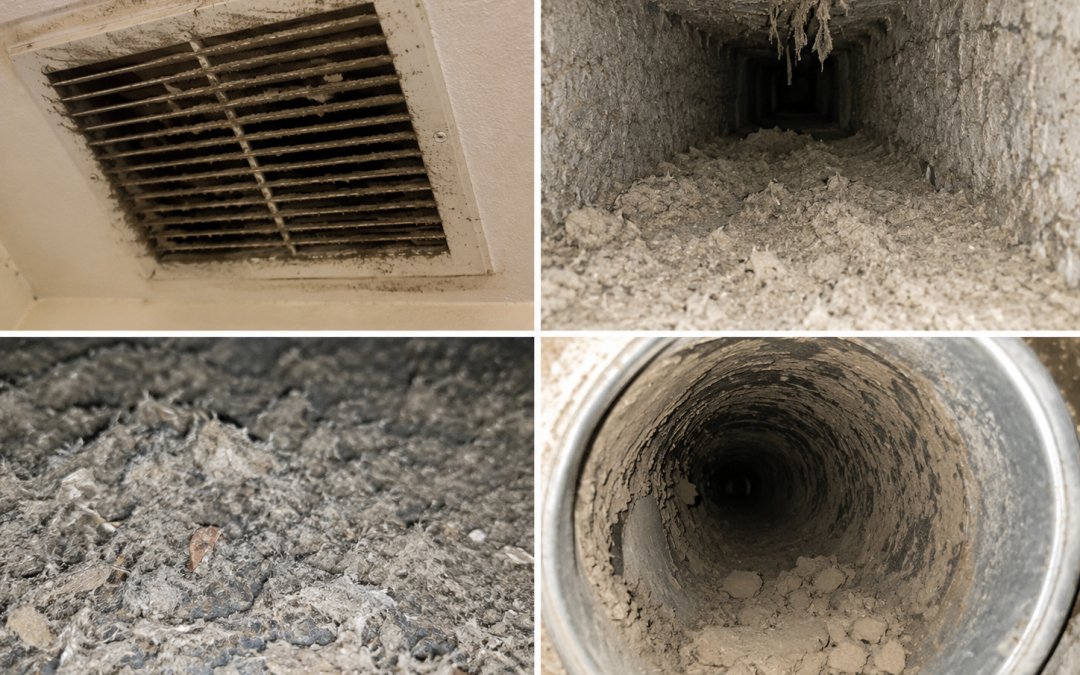
There’s a moment every owner of an older home hits. Maybe it’s the first cold front when the heater kicks on and the whole house smells like burnt dust. Maybe it’s realizing the previous owners lived there 22 years and the inspection report says nothing, anywhere, about the ductwork.
We’ve opened up duct systems across San Antonio for over a decade, in everything from 1940s cottages near Woodlawn Lake to 1990s builds in Stone Oak. New owners always ask the same question: “How bad is it in there?” So this is that answer, organized by the age of your home, based on what we actually pull out of these systems.
First, Why Ducts Are the Forgotten System
Sellers repaint. They replace carpet. Sometimes they even swap the AC unit itself, because a shiny new condenser shows up in listing photos. Ductwork shows up nowhere. It’s behind walls and above ceilings, home inspectors typically only note visible damage, and there’s no disclosure line for “never once cleaned.”
So the ducts become the one system that carries the entire history of the house. Every dog, every remodel, every smoker, every attic critter, every year of South Texas dust. When you buy an older home, you inherit all of it, and then you breathe it.
What We Find, by Era of Home
Homes from the 1950s–60s: Alamo Heights, Terrell Hills, Jefferson
The originals in these neighborhoods often have metal ductwork, which is the good news. Sheet metal lasts, and it cleans up beautifully.
The rest of the story: sixty-plus years of settlement. In these systems we routinely find a debris layer thick enough to hide the duct floor entirely. Construction debris from renovations in the 80s sitting under dust from the 2000s, like geological strata. Original insulation crumbling into the airstream. And in homes this age, the occasional genuinely strange find, newspaper scraps, toy soldiers, things that fell into floor vents during the Johnson administration.
One more era-specific note: some mid-century systems have interior duct linings or tapes from a time when asbestos was standard building material. If your home is pre-1980 and the ducts have never been evaluated, that’s a reason to have a professional look before anyone disturbs anything.
Homes from the 1970s–80s: Windcrest, Live Oak, Universal City, older Converse
This era brought fiberglass ductboard and early flex duct into wide use, and both age differently than metal. Ductboard’s interior surface roughens over decades, which grabs and holds dust far more aggressively than smooth metal. Flex duct from this period sags, and every sag becomes a debris pool.
These are the systems where we most often see what neglect really looks like: matted gray buildup on every surface, returns so packed the system has been suffocating for years, and moisture damage where attic sections lost their insulation wrap somewhere around the Reagan years.
Homes from the 1990s–2000s: Stone Oak, parts of Helotes, early Cibolo and Schertz
“But my home isn’t old,” say owners in these neighborhoods. Your ductwork is now 25 to 35 years old. That’s older than most of the equipment attached to it, because HVAC units get replaced every 12 to 15 years while the ducts stay.
The signature find in these homes is mismatch: a new, powerful system installed onto original builder-grade ducts, sometimes with sections crushed during the equipment swap and never noticed. The new unit pushes harder through the same old restrictions, which is why some owners actually notice worse room-to-room balance after an upgrade. If that’s you, we’ve broken down when duct cleaning fixes airflow and when the problem is something else, because in these homes it’s often both.
The Previous Owners Live in Your Ducts
Beyond the era of construction, ducts hold a record of who lived there:
- Pets. Dander and hair from animals that moved out years ago keeps circulating. If anyone in your family has allergies that flared after moving in, this is suspect number one. Buildup like this is exactly what a full air duct cleaning exists to remove, and it’s the single most common reason new owners of older homes call us.
- Smoking. Tar residue coats duct interiors and keeps off-gassing odor long after the walls have been repainted. That “old house smell” that survived your renovation? Often it’s not the house. It’s the ducts.
- Remodels. Every renovation without sealed vents dumped drywall and sanding dust into the system. Most older homes have had several.
- Rodents and insects. Attic ductwork in older homes develops gaps, and gaps get found. What gets left behind ranges from nesting material to worse, and it’s a health matter, not just a gross one.
The One Appliance Line That’s a Safety Issue, Not a Comfort Issue
While you’re thinking about hidden systems: the dryer vent in an older home deserves attention before almost anything else. Decades of lint in a long vent run isn’t a dust problem, it’s a fuel load. The U.S. Fire Administration attributes thousands of home fires a year to dryers, with failure to clean as the leading factor. Older homes often have the longest, most bend-heavy vent runs, which trap the most lint. A dryer vent cleaning with camera inspection settles the question in under an hour, and you get to see the cleared line yourself on the camera.
Your First-90-Days Checklist as a New Owner
You don’t have to do everything at once. Do this:
- Change the filter immediately, whatever the seller says. Then note how fast the new one loads. A filter graying out in weeks means heavy circulation of particles.
- Do a ten-minute self-inspection. Pull a vent cover and look inside with your phone. We wrote a full walkthrough on checking your own ducts with a phone flashlight, photos included, so you know what normal and not-normal look like.
- Run the startup smell test. Musty at startup means moisture somewhere. Burnt-dust smell on first heat of the season is normal for a day, not a week.
- Ask your neighbors what year the neighborhood was built and what’s typical. In tract-built areas, your neighbor’s duct problems are usually your duct problems.
- If anything looks or smells wrong, get an inspection before a cleaning. Any company that quotes you a price without looking inside your specific system is quoting blind. Independent local guides like this comparison of San Antonio’s best duct cleaning companies can help you build a shortlist of companies that inspect first and show their work.
What “Showing the Work” Should Mean
When we clean an older home’s system, the before-and-after isn’t a sales line, it’s the whole point. You should see photos of your actual ducts before, and your actual ducts after. New owners deserve to know the state of what they bought, and honestly, watching two decades of the previous owners leave your house through a vacuum hose is deeply satisfying.
If you’ve just gotten the keys to an older San Antonio home and want to know what’s been circulating in there since before you signed, schedule an inspection. We’re veteran owned, NADCA certified, and we’ve seen every era of this city’s housing from the inside. Whatever’s in your ducts, it won’t surprise us, and after we show you, it won’t be in there anymore.