
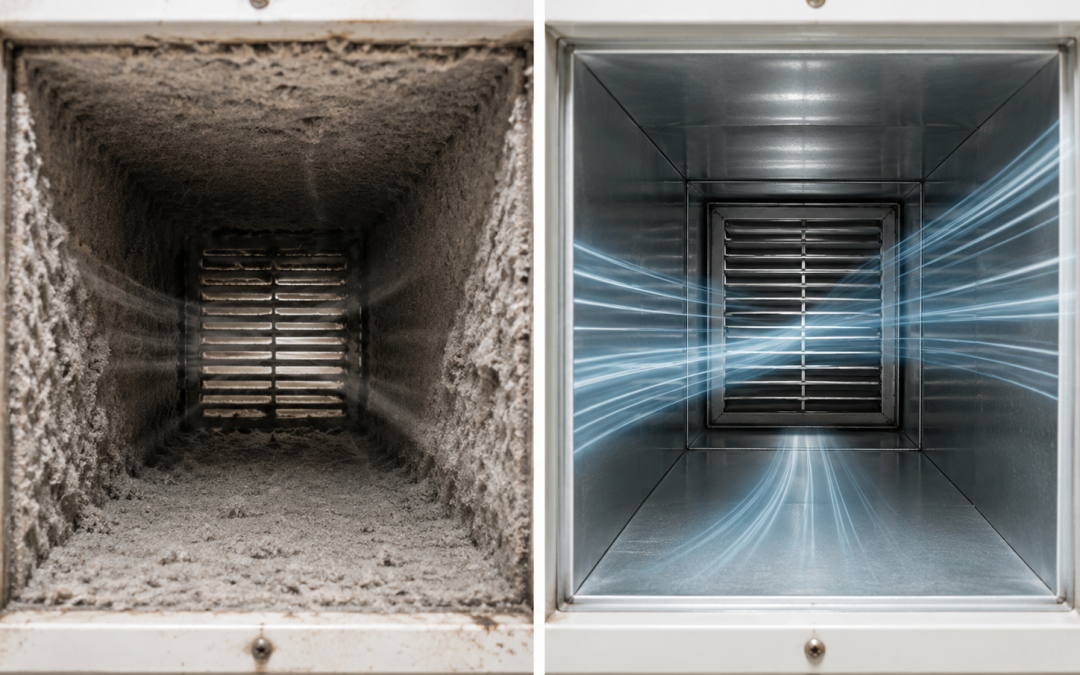
Short answer: sometimes yes, sometimes no, and any company that promises airflow improvement without looking at your system first is guessing.
That might sound strange coming from a duct cleaning company. But we’ve been doing this in San Antonio for over a decade, and the fastest way to lose a customer’s trust is to promise something a cleaning can’t deliver. So here’s the honest breakdown of when cleaning genuinely improves airflow, when it won’t touch the problem, and what’s actually choking the air in most homes we visit.
The Physics
Air moving through a duct behaves like water through a pipe. Three things restrict it: blockage in the path, leaks that let it escape before reaching the vent, and a weak push from the source.
Duct cleaning addresses exactly one of those three: blockage. That’s why the honest answer is conditional. If your airflow problem is a blockage problem, cleaning helps, sometimes dramatically. If it’s a leak or equipment problem, cleaning your ducts is like washing a car with a dead battery.
When Cleaning Genuinely Improves Airflow
Heavy debris accumulation
In neglected systems, especially homes that have gone 10+ years without service, debris does more than coat the walls. It collects at bends, settles in low horizontal runs, and mats against dampers. We’ve pulled out enough material from single homes to fill trash bags. Remove that, and air moves noticeably better.
Blocked or matted registers and returns
Return vents are the lungs of the system, and they’re usually the filthiest part of any home we service. A return grille matted with years of dust and pet hair strangles the entire system’s intake. Your blower can only push out what it pulls in.
Crushed flex duct sections cleared of compacted debris
Flexible ductwork in attics sags over time, and debris pools in the sags. During a proper cleaning, we find these sections, and clearing them restores air paths that had quietly narrowed for years. This is one reason a real cleaning includes a full system inspection first, not just a vacuum at the vent openings.
After renovation work
Drywall dust and construction debris in ducts is its own category. It’s heavy, it settles fast, and it can measurably restrict smaller duct runs. If your airflow got worse after a remodel, the connection is probably not a coincidence.
When Cleaning Won’t Fix Your Airflow
Now the part most companies skip.
Leaky ductwork
According to ENERGY STAR, the typical home loses a significant share of conditioned air through duct leaks, often 20 to 30 percent. If your ducts leak into the attic, the air is being made and pushed, it’s just not arriving. That’s a sealing job, not a cleaning job. No amount of cleaning fixes a hole.
Undersized or badly designed ducts
Some homes, especially fast-built ones, have duct runs that were never sized right for the rooms they serve. That back bedroom that’s always warm? If the duct feeding it is too small or takes three unnecessary bends, it was starved from day one.
A struggling blower or dying capacitor
Weak airflow from every vent at once, especially if it came on gradually, often points at the equipment itself. That’s HVAC repair territory, and a trustworthy duct company will tell you so instead of selling you a cleaning.
A clogged filter
The most common airflow killer in San Antonio homes is also the cheapest: a filter that should have been changed months ago. Check this before you call anyone, including us.
So What Does the Research Say?
The EPA’s official position on duct cleaning is that it hasn’t been shown to prevent health problems in every case, and that cleaning is clearly justified when there’s visible mold, vermin, or ducts clogged with excessive debris. Notice what that last condition is: clogged with debris. Even the most conservative federal guidance agrees that actual blockage is a legitimate reason to clean.
NADCA, the industry’s certifying body, frames it the same way we do: cleaning restores systems to their designed airflow. It doesn’t upgrade a system beyond what it was built to do.
That’s the standard we’re certified against, and it’s why our process starts with an inspection instead of a sales pitch. If we look inside your ducts and blockage isn’t your problem, we’ll point you at what is.
How to Tell Which Camp You’re In
A rough self-diagnosis before anyone comes out:
- Weak air from ONE room only → likely a duct design issue, a crushed or disconnected run, or a pooled-debris sag. Cleaning may help, inspection will tell.
- Weak air everywhere, gradual onset → check the filter first, then suspect the blower or a matted return.
- Weak air everywhere, and the ducts have never been cleaned → blockage is a real candidate, especially with pets or past renovations.
- Good airflow but high bills and uneven temperatures → suspect leaks. Ask about sealing, not just cleaning.
If you want a second opinion beyond ours, independent local comparisons like this guide to San Antonio’s best air duct cleaning companies show how different companies approach diagnostics, and it’s a decent way to spot who inspects before quoting and who quotes before looking.
One More Airflow Culprit Nobody Checks
Your dryer vent. Different system, same principle. A lint-packed dryer vent doesn’t affect your AC, but it’s the most dangerous airflow restriction in the house, because restricted dryer exhaust is a leading cause of residential fires. If it’s been years, dryer vent cleaning takes under an hour and includes a camera inspection so you can see the line is actually clear.
The Bottom Line
Duct cleaning improves airflow when blockage is the problem, and blockage is the problem more often than skeptics claim and less often than bad salesmen claim. The only way to know is to look inside, which is why every air duct cleaning we do starts with a full system inspection, and why we show you before-and-after results instead of asking you to take our word for it.
Curious what’s actually inside yours? We wrote a companion piece on how to check your own ducts with nothing but a phone flashlight before calling anyone. Ten minutes, zero cost, and you’ll know a lot more than you do now.