
Most people book a duct cleaning one of two ways. Either a coupon shows up promising a $99 whole-house special (don’t), or they’ve been vaguely worried about their air for months and finally call someone.
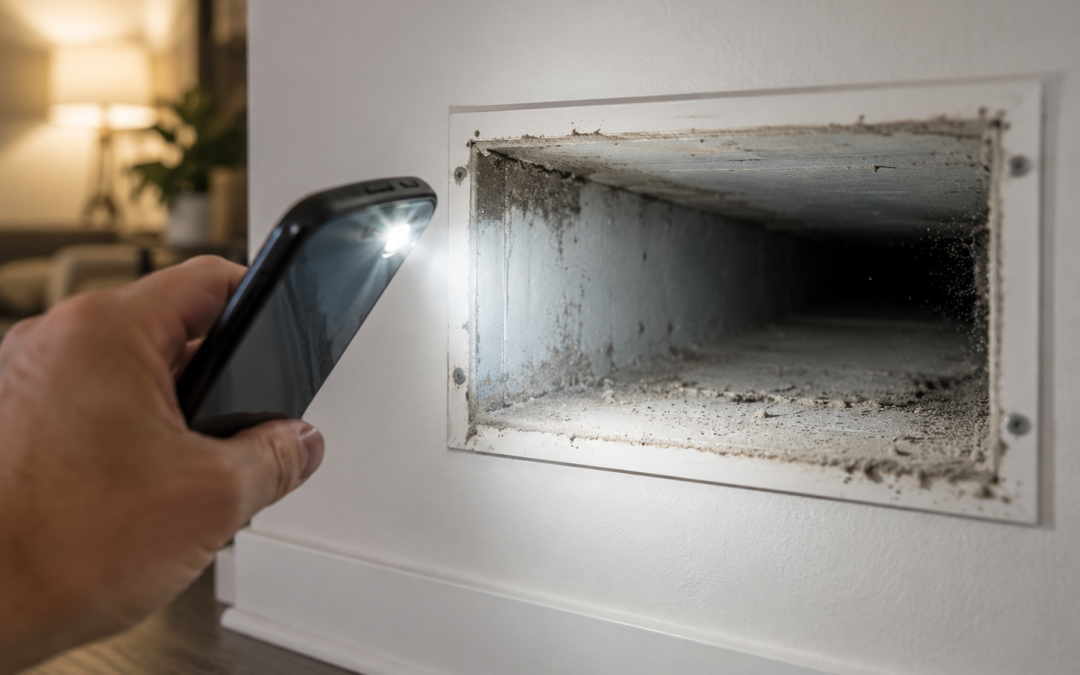
There’s a better starting point, and it’s already in your pocket. Fifteen minutes with your phone flashlight will tell you more about your ductwork than any salesperson will, and it costs nothing. Here’s exactly how to do it, what you’re looking for, and how to read what you find.
What You’ll Need
- Your phone (flashlight and camera)
- A screwdriver, usually Phillips
- A paper towel
- Optional: a selfie stick or an old mirror for seeing around bends
That’s the whole list. No rented cameras, no crawling through the attic.
The 15-Minute Inspection, Step by Step
Step 1: Start With the Return Vent
Your return is the big grille, usually in a hallway or ceiling, that pulls air into the system. It’s the highest-traffic part of your ductwork and the most honest indicator of overall condition.
Kill the system at the thermostat first. Unscrew the grille, set it aside, and look at its back side before anything else. A gray felt-like mat of dust and pet hair on the grille itself already tells you the system has been breathing through a scarf.
Now shine the flashlight into the return cavity. Take photos with flash. You’ll want them later for comparison, or for showing a technician exactly what you saw.
Step 2: Wipe-Test a Supply Vent
Pick a supply vent (the ones that blow air out) in a bedroom, since bedroom vents show typical buildup better than kitchen or bathroom vents, which have their own moisture and grease factors.
Unscrew the cover, then run a dry paper towel one arm’s length along the bottom interior surface of the duct.
Reading the towel
- Light gray film → normal dust. Every duct on earth has some.
- Thick fuzzy gray, visible clumps, or pet hair → meaningful accumulation. Air is passing over this all day.
- Black grime or streaking → could be soot, heavy fine-particle buildup, or something growing. Worth a professional look either way.
- Damp residue or spotted dark patches → moisture is getting in. That’s the one finding you shouldn’t sit on, because in San Antonio humidity, damp ducts and mold in ductwork travel together.
Step 3: The Flashlight Look
With the vent cover off, put your phone into the duct opening, flashlight on, camera in video mode, and slowly pan it around. Watch the recording afterward on your screen where you can zoom in. You’re checking four things:
Walls
Smooth metal with light dust is fine. Walls that look upholstered aren’t.
The bottom of the run
Debris settles low. Screws, drywall crumbs, insulation fluff, dead insects, kids’ toys. A little is history, a layer is a problem.
Any dark spotting
Mold in ducts often shows up as scattered dark speckling rather than a horror-movie patch. If you see spotting, photograph it clearly and stop poking at it. Disturbing mold without containment spreads spores, and the EPA’s mold guidance draws a clear line between small surface cleanup and anything inside HVAC systems, which it says should not be handled as a DIY job.
Light leaks
Turn your bathroom or hallway lights on, then look down the duct with your flashlight off. Seeing light where there should be none means gaps in the duct connections, which leak your paid-for cold air into the attic.
Step 4: Smell Check at Startup
Screw everything back on, turn the system on, and stand at the vent for the first minute. Musty, damp, or stale odors at startup are a moisture flag. We wrote a full breakdown of what causes that musty smell when the AC kicks on if that’s what you find.
Step 5: The Filter Tells on Everyone
Last stop. Pull the filter. If it’s caked, your ducts have been catching what the filter didn’t. If it’s clean because you just changed it, look at how fast the new one loads up over the next month. A filter that grays out in three weeks is catching heavy circulation of particles, and those particles came from somewhere.
Scoring What You Found
You’re probably fine if: light dust on walls, towel came back with a faint gray film, no smells, no spotting, filter loads up on a normal schedule. Recheck in a year. Not every home needs cleaning on a fixed calendar, whatever the coupon says.
Worth a professional inspection if: thick buildup on the towel, matted return grille, visible debris layer on the duct floor, or airflow that feels weak in certain rooms. On that last one, blockage is only one of several causes, and we’ve written honestly about when duct cleaning improves airflow and when it doesn’t.
Don’t wait if: dark spotting, damp residue, persistent musty smell, or any sign of pests. Moisture findings compound in our climate.
What Your Photos Are Worth When You Do Call
Here’s the part that saves you money. When you call any company with photos in hand, you flip the dynamic. Instead of a stranger telling you what’s in your ducts, you’re telling them what you found and asking what they’d do about it. Vague scare tactics don’t work on someone holding evidence.
It also helps you compare companies on substance. Resources like this independent comparison of the best air duct cleaning companies in San Antonio are useful for a shortlist, and your photos are useful for testing who on that shortlist gives you straight answers. Ask each one: “Here’s what I’m seeing, what would your process be?” The answers separate NADCA-certified process from coupon-truck improvisation fast.
We’re happy to be tested that way. Send us what you found or schedule an inspection, and we’ll tell you plainly whether your ducts need work or just need to be left alone. Veteran owned, and we’d rather earn the job in two years than oversell it today.
A Quick Word on What NOT to Do
- Don’t run a shop vac deep into ducts. You’ll stir up more than you capture.
- Don’t spray household cleaners or “mold killers” into vents. Airborne chemistry through your whole house is not the win it sounds like.
- Don’t pressure-wash, steam, or bleach anything in there.
- Don’t go onto attic ductwork itself. Flex duct tears easily, and a torn duct costs more than any cleaning.
Look, photograph, and close it back up. The flashlight is for knowing, not fixing.